A growing number of dentists are finding success employing in-house dental membership clubs, giving the old way of managing a practice a run for its money. In 2025, 29% of dentists dropped insurance networks according to Becker’s Dental + DSO Review. The traditional way of paying for dental treatment may have finally found a worthy alternative, and a dental membership club benefits both the patients who join and the clinicians who run them.
If you’ve been thinking about how to start a dental membership club at your practice, this guide walks you through everything:
- What a dental membership club is
- Why dental membership clubs work
- How to set up your dental membership club
What is a Dental Membership Club?
A dental membership club is a subscription-based alternative to traditional insurance. Patients pay a monthly or annual fee directly to your practice in exchange for preventive care — typically cleanings, x-rays, and exams — along with discounted rates on additional treatments. Think of it as your own in-house dental care plan: no insurance middleman, no reimbursement delays, no pre-authorization headaches. Just straightforward care with transparent pricing that works for you and your patients.
Dental membership clubs go by a few names: dental wellness plan, dental loyalty plan, dental care plan, dental subscription, but the structure is essentially the same. Patients pay for access, you deliver care, and everyone knows what to expect.
Why Independent Practices are Moving Away from PPO Dependence
The case for building a dental membership club starts with a simple frustration most dentists know well: insurance isn’t working the way it used to.
Reimbursements are shrinking. Administrative overhead keeps climbing. Treatment claims get denied. Patients who show up just to use their benefits — and nothing more — aren’t always your most loyal or most valuable.
A dental membership club changes that equation. When you know how to start a dental membership club and execute it well, you collect 100% of the service fee for every member. You stay in the driver’s seat of your business. According to ADANews, dental memberships help support patient retention, generate predictable revenue, and streamlined administration.
That’s why practices that are serious about independence are asking not just whether to launch a membership club, but how — and which setup gives them the most control.
Before getting into how to start a dental membership club, it’s worth understanding your options — because most practices launching a club face the same two options, and neither one is as good as it first appears.
DIY (Do-It-Yourself)
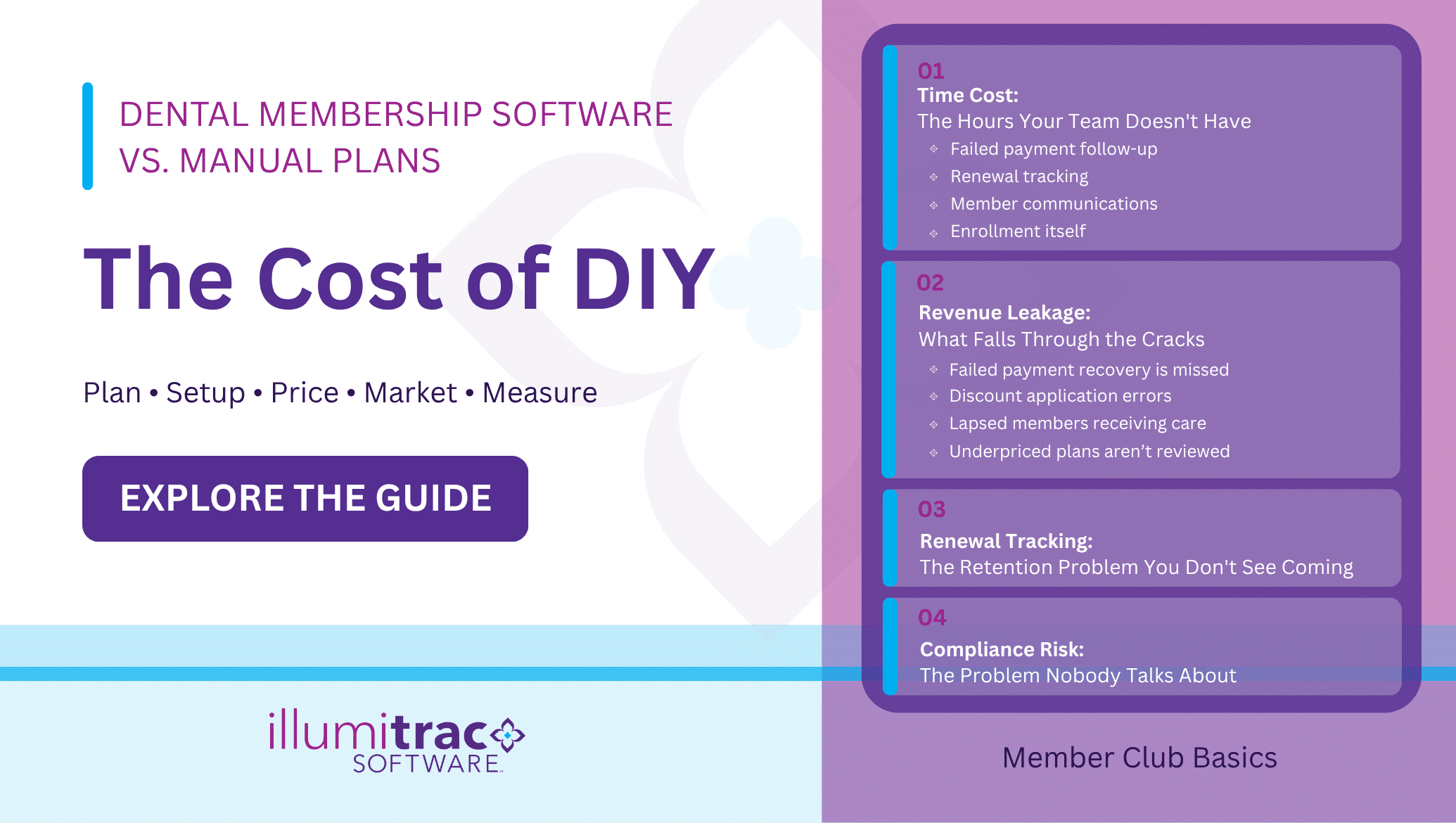
You build the membership program completely by yourself: spreadsheets, manual billing reminders, and whatever systems your front desk can piece together. It seems appealing as a cost-saver because you’re not paying anyone else, but the reality is a significant admin burden: tracking renewals, chasing payments, managing member communications, and handling cancellations all fall on your team. This model doesn’t scale, so as your club grows — the manual work grows with it. You end up trading insurance headaches for a different kind of operational weight, with no clear picture of how much heavier it will get.
Third-Party Vendor Hosted Clubs
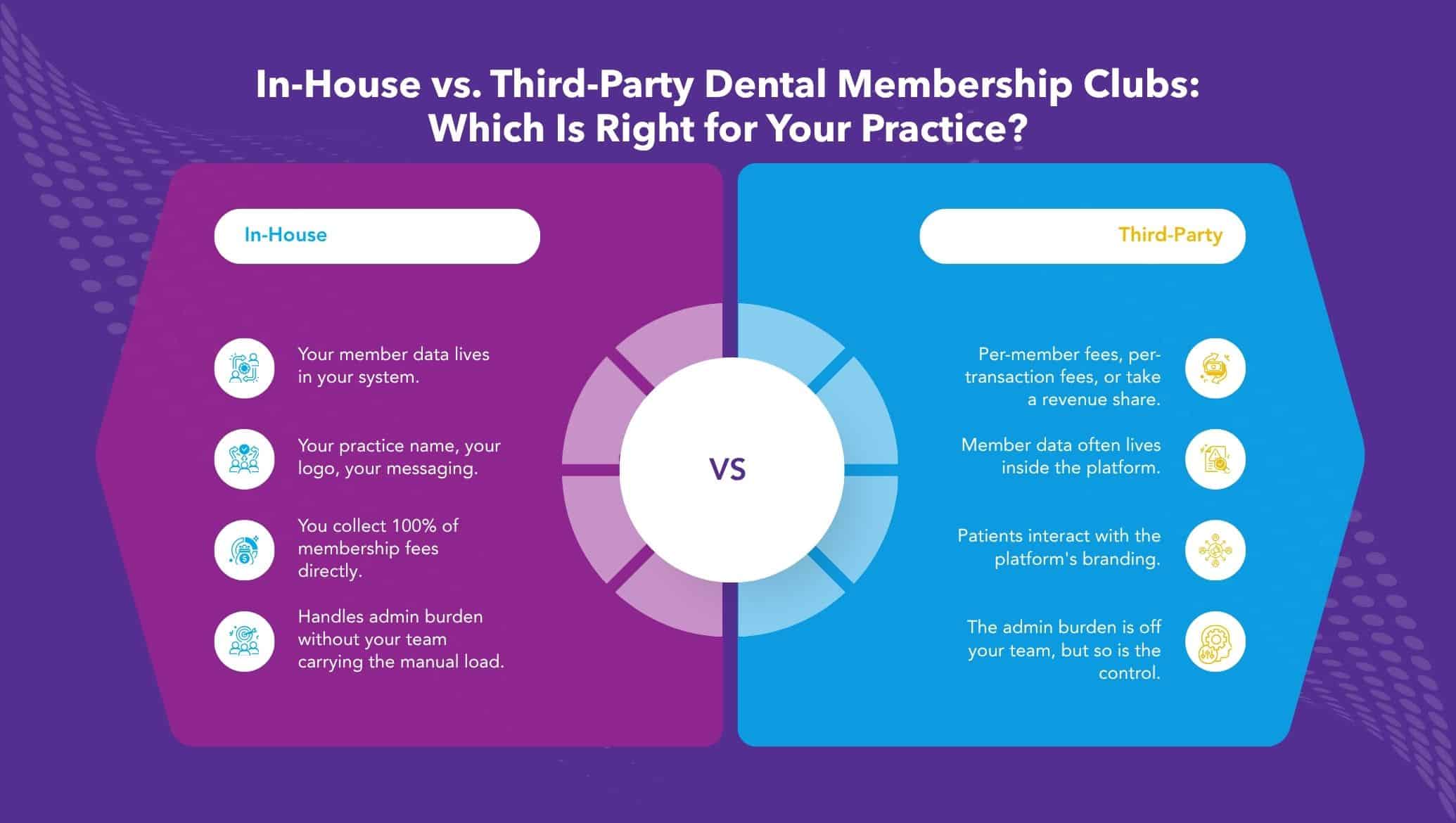
You hand the operational burden to an outside platform. They run the program, handle the billing, and take the admin load off your team — but you pay for that convenience in ways that compound over time. You don’t own your data because member data often lives inside their system, not yours. And a portion of your revenue flows through their system as per-member or per-transaction fees taken from your revenue erode your margin as the club grows. If you ever want to leave, you may not be able to take your members with you. You’ve essentially outsourced ownership of the club you built.
Neither option is ideal for modern and independent dental practices. One trades your team’s capacity for revenue. The other trades your revenue — and your data — for convenience. If those are the only two options, a dental membership club starts to look like a different version of the insurance problem you’re trying to escape.
The Better Way: illumitrac’s In-House Solution
illumitrac was built to solve what the other options get wrong.
With illumitrac, your club is fully in-house — your practice’s name, your patient relationships, your data, and your revenue. We handle the backend setup, train your staff, and give you the tools to run and grow the club without the manual overhead of DIY. Unlike third-party hosted platforms, you pay one time for access to the software and we don’t lock you into a system you can’t leave with your members intact.
You get the ownership of DIY and the operational ease of third-party — without the trade-offs of either.
There’s one more distinction worth making: illumitrac is not a discount dental plan. Discount plans give patients access to dental care at reduced rates, but they don’t keep patients in the chair. illumitrac clubs are structured to bring members back every six months, which means more recall visits, more opportunities to diagnose treatment, and patients who say yes to that treatment at twice the rate of non-members. That’s not a coupon — that’s a revenue engine.

Practice Benefits of an In-House Dental Membership Club
As in-house membership plans become more popular, dental practice owners and associates are seeing the benefits of pivoting to a subscription-based business. Here are the three primary benefits:
Increased Patient Retention
Patients who are members have a reason to come back and a financial stake in doing so. Their payments are already set up, they know what’s included, and they’re not making decisions based on whether their insurance covers a visit. That structure creates loyalty that insurance-driven patients rarely provide.
“We’ve had significantly less people drop off hygiene because they feel cared for and like they can come in for free.”
Ziegele Smile Studio
Anne, Office Manager
We consistently see membership clubs improve patient retention because they shift the relationship. Patients aren’t insurance-bargain shopping anymore. They chose your practice, and the membership reinforces that decision every time they book an appointment.
Predictable, Recurring Revenue
One of the most clear reasons why membership plans matter to the business side of your practice: you know what’s coming in. When you understand your member count and your monthly fee, you have a reliable revenue baseline to build on. That predictability makes planning, hiring, and investing in your practice significantly easier.
A dental subscription pricing model — whether billed monthly or annually — turns what used to be unpredictable appointment revenue into a steady, forecastable income stream.
Focus On Preventive Care
Dental membership clubs are built around prevention. Members are encouraged to use the cleanings and exams included in their plan, which means more regular visits, earlier detection of issues, and less need for costly restorative work down the road. That’s better for your patients — and better for your chair time.
Patient Benefits of Joining a Dental Membership Club
Understanding why patients value a dental wellness plan is just as important as knowing the business case. These are the three most common reasons patients say yes to membership:
Cost Savings
For the roughly 72 million Americans without dental insurance (according to CareQuest Institute for Oral Health’s 2024 State of Oral Health Equity in America survey), an in-house dental care plan is often the most affordable way to maintain consistent oral health care. Your membership can cover preventive services and offer discounts on additional treatments — giving uninsured patients a real path to care that doesn’t rely on emergency visits or avoidance.
Transparent Pricing
Patients don’t like surprises at checkout. A dental membership club eliminates that anxiety. The cost is clear upfront, the covered services are spelled out, and patients can budget for their care on a monthly or annual basis. You can reinforce that confidence with intake materials that walk new members through exactly what their membership includes.
Personalized Care
When you’re not beholden to insurance decisions, you can treat patients the way your clinical judgment says they should be treated. No waiting on prior authorizations. No reimbursement limitations dictating material choices. Your expertise drives the treatment plan — which is what your patients came to you for.
How to Start a Dental Membership Club: Step-by-Step
You don’t have to do this alone — illumitrac is the pioneer of dental membership club automation. We work with thousands of dentists nationwide to increase your practice revenue.
Here’s how to create a dental membership plan that runs smoothly from day one.
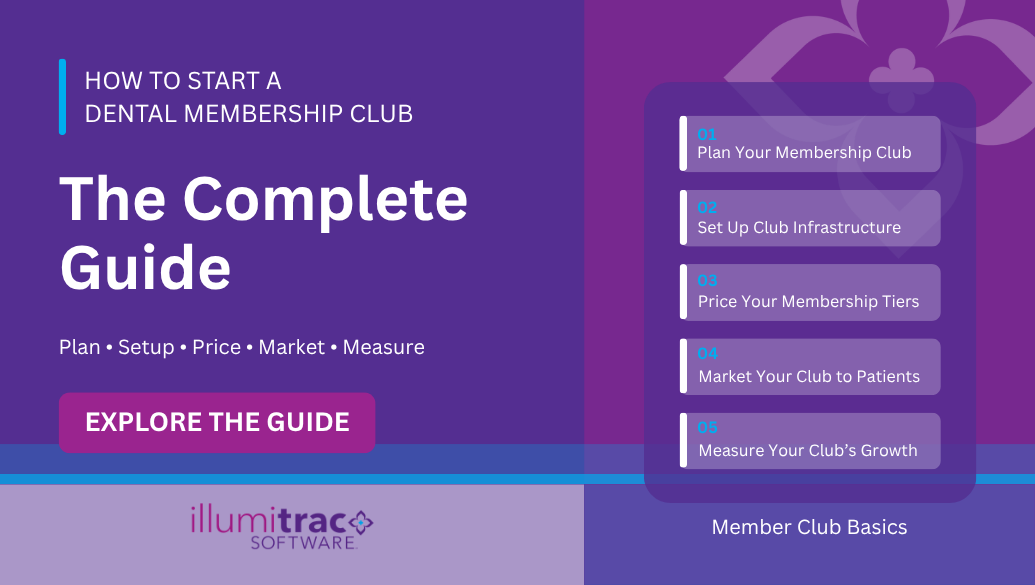
Step 1: Plan Your Membership Club
As with any new program or system, it is recommended to focus on decision-making opportunities at the beginning in order to streamline execution later on. For a dental membership plan, you should first consider what is important to your practice and what will provide the most value to your patients.
Start by defining the fundamentals before you build anything:
Define your target member.
Are you primarily serving uninsured patients? Patients who are aging out of employer coverage? Families? Understanding who the club is for helps you design a plan that speaks to them.
Decide on membership tiers.
Most practices offer one to three tiers — a base plan covering preventive care, and optional enhanced plans that add additional services or deeper discounts. Keep it simple enough that your front desk can explain it in 60 seconds.
Set your geographic scope.
Are you launching practice-wide, or piloting at one location first? Multi-location practices should think through how the club will scale from the start.
Identify an internal owner.
Someone on your team needs to be the club champion — typically your office manager or a designated front desk lead. Without clear internal ownership, even well-designed clubs stall at launch. Of course, our onboarding team and illumitrac Club Success Coaches will be there each leg of the journey to assist your team.
Step 2: Set Up Club Infrastructure
Once your plan is designed, you need the systems to run it:
Choose your platform.
As covered above, in-house software gives you the most control and the cleanest patient experience. Your platform should handle enrollment, billing, renewals, and member communications without burdening your front desk.
Configure your membership tiers.
Every covered service, every discount rate, and every billing interval should be built into the platform before you start enrolling members.
Prepare member-facing materials.
This includes enrollment forms, a welcome packet, and a clear summary of what membership includes. Your patients should feel like they’re joining something — not just signing a form. illumitrac will help you develop every asset needed to make your club as successful as it can be.
Train your team.
Every person who talks to patients should be able to explain your dental membership club confidently, handle common objections, and enroll a new member from start to finish. illumitrac handles staff training as part of our onboarding process.
Step 3: Price Your Membership Tiers
Pricing is where most practices overthink things. Here’s a straightforward framework:
Start with your cost of care.
Add up the cost of delivering the preventive services you plan to include — typically two cleanings, two exams, and necessary x-rays annually. That’s your floor.
Layer in a margin.
Your membership fee should cover the cost of care and contribute to overhead. Most practices price in the range of $35–$40 per month for a base adult plan, though this varies by market and service mix.
Factor in your discount structure.
If members receive 15–20% off additional services, model out what that looks like at average treatment acceptance rates so you’re not underpricing.
Compare to what patients currently pay.
Your membership should represent clear value compared to what an uninsured patient would pay out of pocket for the same care. If it doesn’t, revisit your tier pricing.
Review pricing annually.
As your club grows and your cost structure changes, revisit your pricing to make sure it still works. Your illumitrac Club Success Coach will reach out to you to help you with annual increases so you don’t have to figure everything out by yourself.
Don’t need annual price changes? No problem, illumitrac can be set up as a “set it and forget it” pricing update model. You set the recurring pricing update, and the software notifies patients — by their state regulations. Each state has different requirements, and illumitrac takes all the guesswork out of updating pricing and keeping them compliant.
Step 4: Market Your Club to Patients
The best dental wellness plan in the world doesn’t grow if patients don’t know about it. Here’s where to focus marketing your membership:
Start with your existing patient base.
Your uninsured patients are your most immediate opportunity. A targeted email or text campaign to patients without insurance on file — letting them know about your new dental care plan — can generate early enrollments quickly.
Train the front desk to present membership at relevant touchpoints.
New patient exams, treatment plan presentations, and recall appointments are all natural opportunities to introduce the club. It shouldn’t feel like a sales pitch — it should feel like solving a problem the patient already has.
Make it visible in your office and on your website.
Waiting room signage, a card at the front desk, and a page on your website all help normalize membership as part of how your practice operates. With illumitrac software, your branding is the only branding patients will ever see. We also offer to generate marketing materials for your club so you can focus on what matters most — working with your patients.
Include it in your new patient workflow.
Every new patient who doesn’t have insurance should hear about your club on their first visit. Don’t wait for them to ask — be proactive!
Step 5: Measure Your Club’s Growth
A dental membership club compounds over time and you need data to know whether it’s growing the way it should.
Track core metrics closely.
- Active member count: total enrolled members across all tiers
- Monthly recurring revenue (MRR): membership payments received each month (can be generated yearly as well)
- Churn rate: members lost per month as a percentage of total
- Average revenue per member: accounting for included services and discounts used
- Member vs. non-member treatment acceptance rate: members almost always accept more treatment, and tracking this makes the case internally for growing the club
- New member enrollment rate: how many new members you’re adding per month
Set a 12-month growth target.
Most practices that commit to their practice growth through a dental loyalty plan see membership double in the first year when they have a consistent enrollment process and active team buy-in. Thankfully, illumitrac has a built-in, goal-setting feature so you can easily keep track of where you’re headed — and where you are at.
Review quarterly with your team and Club Success Coach.
Share the numbers with your front desk and clinical team. When they see the club growing, they become better advocates for it. Your dedicated Club Success Coach is happy to help you with reporting and club analytics.
Ready to Launch Your Dental Membership Club
Starting a dental membership club is one of the highest-leverage moves an independent practice can make for their revenue, patient relationships, and independence from insurance.
The practices that do it well don’t start from scratch. They use software built for this, get their team trained, and launch with a plan.
That’s what illumitrac is built for. Now that you know how to start a dental membership club, let us build your program, train your staff, and give you the tools to grow it — all without revenue sharing or third-party data ownership.
Check Out More Dental Membership Club Software Insights On The illumitrac Blog: