There’s a version of a dental membership plan that sounds perfectly reasonable at the start: build a simple spreadsheet, run payments through your existing processor, have the front desk track renewals, and keep more of the revenue by not paying for software. It’s the DIY approach — and for a lot of practices, it’s where the dental membership club journey begins.
The problem isn’t that it doesn’t work. But, the costs of doing it manually grow quietly until they turn into much bigger problems — and by then, the damage to revenue, staff capacity, and patient retention is already done.
Today we’re exploring dental membership software vs. manual plans. We’ll compare how much manual membership management really costs, stage by stage — and what membership automation changes.
What “Manual” Actually Looks Like in Practice
Before getting into the costs, it’s worth being specific about what a manual dental membership plan involves. Most practices running DIY clubs are managing some combination of the following:
- A spreadsheet (Google Sheets or Excel) tracking member names, plan tier, enrollment date, and billing date
- Manual payment collection via credit card on file, ACH, or recurring charges set up through a general-purpose processor
- A front desk workflow — usually informal — for presenting the plan to new patients and collecting payment
- Calendar reminders or post-it notes for renewal follow-up
- No automated member communications — reminders, receipts, and renewal notices sent manually or not at all
- No safety net via legal agreements around compliance
This works at 10 members. It starts to strain by 30. By 100 members, it’s consuming a meaningful chunk of your front desk’s capacity every week — and that’s before a card declines, a patient disputes a charge, or your office manager leaves and takes institutional knowledge of the system with them.
The Real Costs of Running a Manual Dental Membership Plan
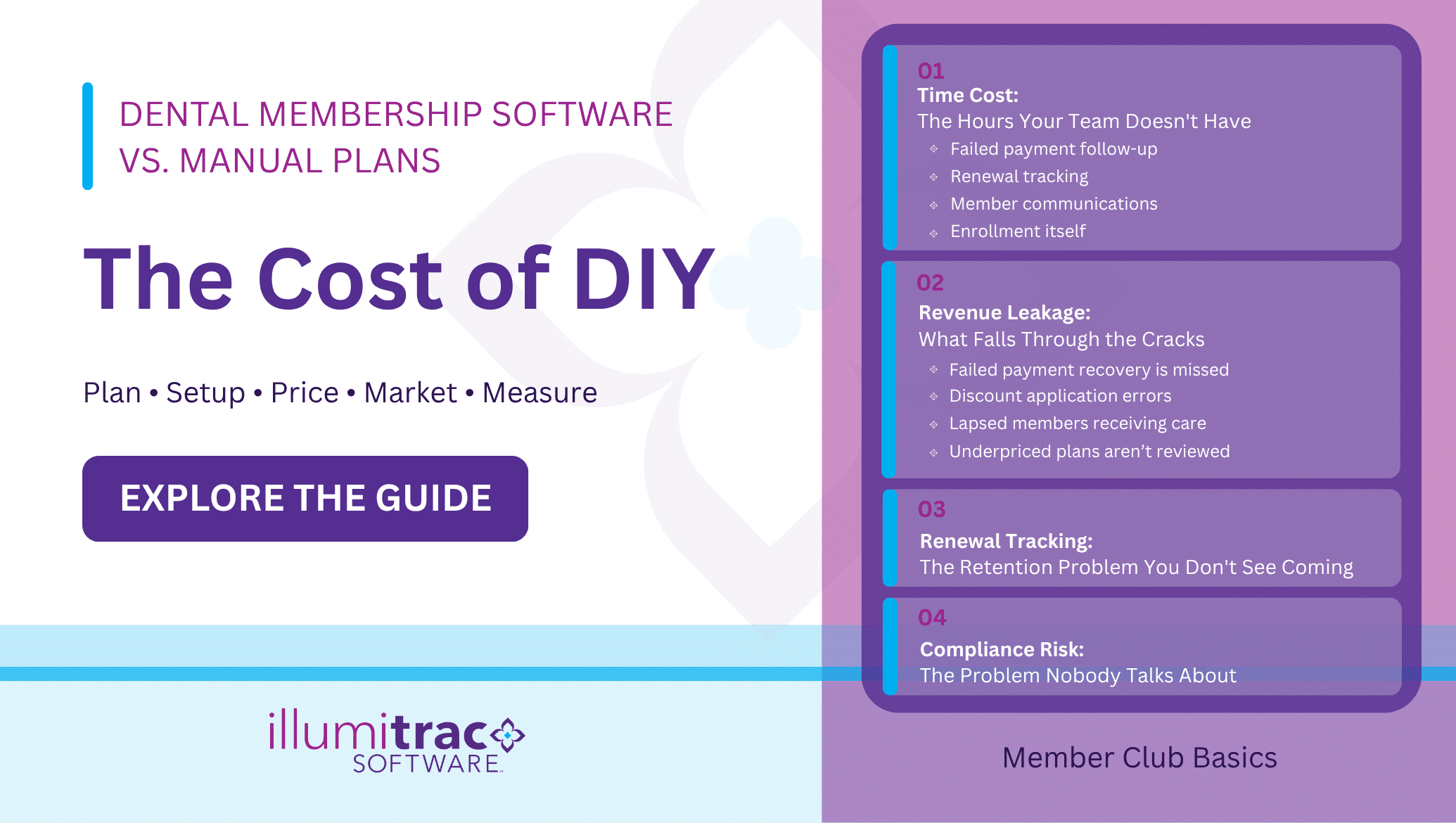
1. Time Cost: The Hours Your Team Doesn’t Have
The most significant and least-tracked cost of a manual membership plan is staff time. Every task becomes a recurring manual responsibility:
Failed payment follow-up.
When a card declines on a manual plan, someone has to notice it, find the patient’s contact information, reach out, collect updated payment details, and reprocess. On a software platform, retry logic handles this automatically. On a spreadsheet, it sits until someone catches it — which often isn’t until the next billing cycle.
Renewal tracking.
Annual members need to be identified as they approach renewal, communicated with proactively, and re-billed. Monthly members need consistent monitoring for lapsed payments. Without automation, this is a recurring calendar task that stacks.
Member communications.
Welcome emails, benefit reminders, renewal notices, payment receipts — on a manual plan, none of these happen unless someone manually sends them. Most practices running DIY clubs send far fewer communications than they intend to, which quietly erodes member engagement and increases churn.
Enrollment itself.
A manual enrollment process — collecting information, setting up billing, logging the member, and explaining benefits — can take 10–15 minutes per patient when it isn’t systematized. illumitrac’s enrollment takes under 90 seconds. Multiply that difference across every new member and every recall visit where membership gets presented, and the time savings become significant fast.
2. Revenue Leakage: What Falls Through the Cracks
Manual systems don’t fail dramatically. They leak quietly — and the revenue that escapes rarely gets traced back to the system that let it out.
Payment recovery is missed.
Failed payments don’t only cost your team in time, they also add up to real dollars lost. The average failed payment rate on recurring billing is 5–10%. On a software platform with retry logic and card updater functionality, the majority of those are recovered. On a manual plan, most practices don’t realize it lost that revenue at all.
Discount application errors.
Without a system tracking what each member’s plan includes, front desk staff make judgment calls at checkout. Some members get discounts they’re not entitled to. Some don’t get the ones they are. Both outcomes cost the practice money — one directly, one in member dissatisfaction.
Lapsed members receiving care.
This is one of the most common and most expensive failure points of a manual plan. Without a real-time member status check at the point of service, it’s easy for a lapsed member to come in for their “included” cleaning without anyone catching that their membership expired two months ago. The practice delivers the care and absorbs the cost.
Underpriced plans that never get reviewed.
Dental membership software platforms surface the data you need to make informed pricing decisions. A manual plan usually doesn’t — which means pricing set at launch tends to stay static long past the point where it should have been adjusted, quietly eroding margin as costs rise.
3. Renewal Tracking: The Retention Problem You Don’t See Coming
Renewal is where manual membership plans are most vulnerable — and where the difference between DIY and software is most visible.
A patient who enrolled 11 months ago is approaching their annual renewal. On a software platform, they’ve received automated touchpoints throughout the year: a welcome message at enrollment, benefit reminders mid-year, and a renewal notice 30 days out. By the time renewal arrives, they’ve been consistently reminded of the value they’re getting. Renewal is expected.
On a manual plan, that same patient has likely heard very little since they enrolled. The renewal notice — if it goes out at all — is the first communication they’ve received in months. They’ve had 11 months to forget why they signed up, and one conversation to remember. The renewal rate reflects exactly that.
A practice with a 90% renewal rate doubles its retained revenue base every few years. A practice with a 60% renewal rate is on a treadmill, constantly re-enrolling to replace members it’s losing, without ever building the compounding base that makes a mature club genuinely profitable.
The difference between those two outcomes is almost entirely communication cadence — and communication cadence is almost entirely a function of whether it’s automated or manual.
4. Compliance Risk: The Problem Nobody Talks About
This is the cost most DIY practices don’t discover until something goes wrong.
When a patient enrolls in a manual membership plan, they typically sign whatever form the practice has put together. All too often, it’s a simplified agreement that doesn’t fully cover cancellation terms, auto-renewal disclosure, or refund policy. There’s no standardized flow ensuring they’ve acknowledged the terms of service. There’s no system confirming they received an auto-renewal reminder before being billed for another year.
That exposure is manageable when everything goes smoothly. Disputes do happen, particularly around annual renewals when the patient forgot they were enrolled. When a patient disputes a charge, the practice is left reconstructing what was communicated, when, and with what documentation.
illumitrac’s club automation software platform builds compliance into the enrollment flow. Patients acknowledge terms of service at signup. Auto-renewal disclosures are built into the communication cadence. The paper trail exists because the system creates it, not because someone remembered to save it.
Side-by-Side: Dental Membership Software vs. Manual Plans
| Manual / DIY | illumitrac Software | |
| Enrollment Time | 10-15 minutes per patient | Under 90 seconds |
| Failed Payment Recovery | Manual follow-up, often missed | Automatic retry logic + card updater |
| Member Communications | Ad hoc, inconsistent | Automated welcome, reminders, receipts |
| Renewal Tracking | Calendar reminders, manual outreach | Automated renewal sequence |
| Lapsed Member Detection | Caught at checkout (if caught at all) | Real-time member status |
| Discount Application | Staff judgement call | Plan tier controls what is applied |
| Compliance Documentation | Practice-assembled forms | Built into enrollment flow |
| Pricing Review Support | On your own | Dedicated Club Coach, early outreach |
| Revenue Visibility | Spreadsheet totals | MRR / ARR dashboard + reporting |
| Scales to 200+ Members | No | Yes |
When DIY Makes Sense — And When It Doesn’t
To be fair: a manual plan isn’t wrong for every practice at every stage. If you’re running a pilot with fewer than 20 members to validate demand before committing to software, a simple DIY setup is a reasonable proof of concept. The risk is low, the admin burden is manageable, and you’ll learn quickly whether your team will actually present the plan consistently.
The problem is that most practices stay in DIY mode well past the point where it makes sense. Unfortunately, the costs are invisible and the friction of switching feels higher than the friction of the status quo. By the time the manual burden becomes undeniable, the practice has often lost months of compounding renewal revenue and accumulated gaps in member communication that are hard to close retroactively.
The right time to move to software isn’t when the manual system breaks. It’s before it does, when the club is small enough that the transition is clean and the compounding benefits of automation have the longest runway to work.
What the Switch Actually Looks Like
The most common concern practices have about moving from a manual plan to software is the disruption of migrating existing members and retraining staff on a new system.
With illumitrac, the transition is handled as part of onboarding. Your Club Success Coach manages the setup, helps migrate existing member data, and trains your team on the enrollment workflow and patient conversation before you go live. Most practices are fully operational within the first week. The front desk learns one enrollment flow, and from that point forward, the system handles everything they used to manage by hand.
The Bottom Line
Running a dental membership plan manually isn’t free. It costs staff time, renewal revenue, member retention, and compliance confidence — all quietly brewing behind the scenes until the damage is already done..
Dental membership software vs. manual plans isn’t only a cost comparison. It’s also a capacity comparison. What can your team realistically sustain as your club grows? And, what does the revenue difference look like between a plan that compounds and one that leaks?
The practices that build real, lasting membership revenue don’t do it on spreadsheets. They build on systems designed for exactly this — and they start before the manual burden makes the decision for them.
Ready to get started? Schedule a Discovery Call →
Check Out More Dental Membership Club Software Insights On The illumitrac Blog: