You’ve already decided that a dental membership club is the right move for your practice. The case is clear: predictable revenue, stronger patient retention, freedom from insurance dictating your treatment decisions. The question you’re facing now isn’t whether to build a club — it’s how to build one, and specifically, whether to run it fully in-house or hand it off to a third-party platform.
That’s not a small decision. The structure you choose determines how much revenue you keep, who owns your patient data, what your patients see when they enroll, and whether the equity you’re building belongs to your practice or someone else’s platform.
This guide breaks down the key differences between an in-house dental membership plan vs. third-party plans so you can make the call with full information.
Untangling the PPO Mess
If you’ve been running on PPOs, you already know the problem. Reimbursements are shrinking. Administrative overhead keeps climbing. Insurance companies push for less expensive or outdated treatment options, prioritizing cost containment over patient care. That’s not a sustainable model for a practice trying to grow.
A dental membership club is the most direct path out — but the structure you choose matters more than most people realize when they first start evaluating options.
The practices that end up frustrated with their membership club usually made one of two mistakes: they tried to build it themselves without the right infrastructure, or they handed it to a third-party platform without understanding the trade-offs buried in the fine print.
The 5 Barriers That Keep Patients From Saying Yes to Care
Before comparing an in-house dental membership plan vs. third-party platforms, it’s worth understanding the patient-side problem you’re solving. A well-structured dental membership club removes the five most common reasons patients delay or avoid care:
Cost of Care
Unpredictable out-of-pocket expenses are the number one reason uninsured patients avoid the dentist. A membership with a fixed monthly or annual fee eliminates that anxiety — patients know exactly what they’re paying and what they get. Bundling preventive services into a predictable cost makes patients far more likely to prioritize their care, reducing the downstream need for expensive restorative treatment.
Insurance Complexities
For patients without coverage, navigating dental care feels difficult and overwhelming. A membership club replaces that complexity with a simple, direct relationship: they pay your practice, they get care. No networks, no EOBs, no confusion about what’s covered.
Fear & Avoidance
Patients who feel uninformed are more likely to avoid treatment. When your membership includes educational touchpoints — not lectures, but genuine guidance on what their care includes and why — you build the kind of trust that keeps patients in the chair and accepting treatment.
Scheduling Friction
When preventive visits are already built into the membership, patients have a natural reason to book. The cleanings and exams aren’t an expense they’re weighing — they’re already paid for. That shift in framing drives recall compliance significantly.
Lack of Personalized Options
One-size-fits-all plans don’t serve a diverse patient base. Offering one to three membership tiers — with options for different service needs and budgets — makes your club accessible to a wider range of patients, including families, seniors, and uninsured or underinsured adults who represent your highest-opportunity audience.
The right membership infrastructure makes all five of these easier to solve. The wrong one creates new versions of the same friction.
The 7 Costs of Staying PPO-Dependent
Understanding the in-house dental membership plan vs. third-party question also requires understanding what you’re walking away from. The ADA Health Policy Institute reports that 1 in 5 dentists is cutting ties with insurance — and the reasons go deeper than just reimbursement rates.
Here’s what PPO dependence actually costs your practice:
1. Financial Margin
Insurance reimbursements are squeezed every year. Covering operating costs, investing in equipment, and maintaining your team all get harder as your revenue gets cut.
2. Clinical Autonomy
One of the most clear reasons why membership plans matter to the business side of your practice: you know what’s coming in. Insurance restricts your ability to recommend the best treatment, prioritizing cost containment over patient care. When you understand your member count and your monthly fee, you have a reliable revenue baseline to build on. That predictability makes planning, hiring, and investing in your practice significantly easier.
3. Patient Satisfaction
Patients who receive limited treatment options — even when those limitations aren’t your choice — associate that experience with your practice. Your reputation absorbs the impact of insurance’s decisions.
4. Administrative Capacity
Insurance billing is complex, constantly changing, and extraordinarily time-consuming. Every hour your team spends on claims is an hour not spent on patient care or practice growth.
5. Patient Loyalty
Insurance-driven patients follow their benefits, not their dentist. When their plan changes, so does their provider. A membership patient chose your practice specifically — and the membership reinforces that relationship every time they book.
6. Team Morale
Financial strain, restricted treatment options, and administrative burden compound into burnout. When you feel unable to deliver the standard of care you trained for, it shows.
7. Professional Identity
You invested years and significant resources becoming an expert in your field. Professional autonomy isn’t a perk — it’s the foundation of good care. Anything that erodes it also erodes your practice and your bottom line.
In-House Dental Membership Plan vs. Third-Party Platform: The Core Differences
Here’s where the comparison gets specific. When evaluating an in-house dental membership plan vs. a third-party platform, there are five dimensions that matter most to your long-term practice equity.
Revenue Ownership
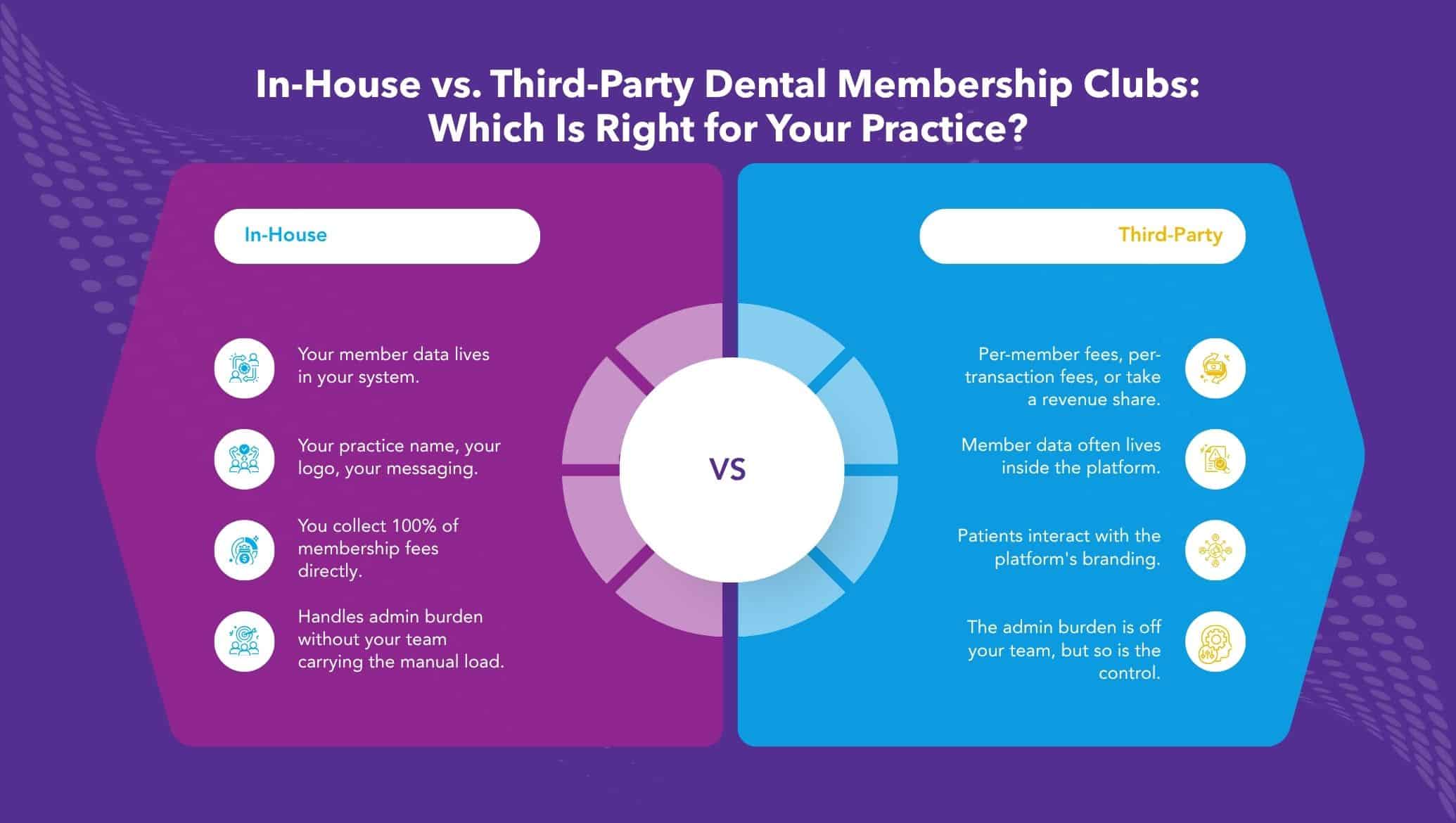
In-house: You collect 100% of membership fees directly. Your pricing is your pricing. No percentage flows to a platform, no per-member fee erodes your margin as you scale.
Third-party: Most platforms charge per-member fees, per-transaction fees, or take a revenue share. The cost may feel manageable at 50 members. But at 500 members, you’re writing a meaningful check to someone else’s platform every month — for a club you built.
Data Ownership
In-house: Your member data — contact information, payment profiles, visit history, enrollment dates — is white-labeled. You own it and can use it however your practice needs because your patients stay with your practice — not just with your club.
Third-party: Member data typically lives inside the platform’s infrastructure. If you leave — or if they change their terms, get acquired, or shut down — you may not be able to take your patient list with you. You’ve built an audience on someone else’s land.
Branding & Patient Perception
In-house: Patients enroll in your club. Your practice name, your logo, your messaging. The membership reinforces your brand at every touchpoint — enrollment, welcome communications, renewal reminders.
Third-party: Patients often interact with the platform’s branding, not yours. The club they joined may feel like it belongs to a vendor rather than to their dentist. That’s a subtle but real erosion of the relationship you’re trying to build.
Administrative Control
In-house software: The platform handles enrollment, billing, renewals, and member communications on your behalf — without your team carrying the manual load. You get the ease of a managed system with the ownership of an in-house club. Enrollment takes as little as 90 seconds per patient, so your front desk isn’t slowed down even on busy days.
True DIY: You build and maintain everything yourself. Spreadsheets, manual billing, chasing renewals. It’s the highest-ownership option, but it doesn’t scale — and as your club grows, the manual overhead grows with it in ways that eventually undercut the time savings you built the club to create.
Third-party hosted: The administrative burden is off your team, but so is the control. You’re running your club inside their rules, their interface, and their business model.
For more information about the different types of dental membership plan options, read about it in this guide.
Long-Term Practice Equity
This is the dimension most practices undervalue when they’re first evaluating options. A dental membership club is an asset. Your member base, your recurring revenue, your renewal rates — these have real value when you’re planning for growth, bringing on an associate, or thinking about an eventual transition.
If your club lives on a third-party platform, that asset is encumbered. The value you’ve built is partially theirs. An in-house club — with your data, your revenue stream, and your patient relationships fully intact — is yours to grow, transfer, or leverage however your future requires.
Building a Membership Club In-House
illumitrac is built specifically for the in-house model — and for the practices that want the ownership of DIY without the operational weight of building it themselves.
When you run your club on illumitrac, you get:
- Full revenue retention: no per-member fees, no revenue share. illumitrac is paid through patient membership fees, never out of your revenue
- Complete data ownership: your members, your records, your lists
- Your branding only: patients never see illumitrac; they see your practice
- Managed infrastructure: enrollment, billing, renewals, and member communications are handled without burdening your front desk
- Staff training and onboarding: your team gets up to speed through our onboarding process, with Club Success Coaches available throughout
- Annual pricing support: your Club Success Coach helps you manage annual increases so you’re not figuring it out alone
- Reporting and analytics: track active members, MRR, churn, and treatment acceptance rates from your dashboard
And one more thing worth stating directly: illumitrac is not a discount dental plan.
Discount plans reduce fees. They don’t keep patients in the chair. illumitrac clubs are structured around recall — members come back every six months, which means more visits and more opportunities to diagnose treatment.
| Members say yes 2X the rate of non-members.
That’s not a coupon. That’s a revenue engine built into the structure of the club itself.
How to Evaluate Your Options: A Quick Framework
If you’re still weighing your choices, run each option through these five questions:
- Who owns the member data if I leave?
- What does this cost me per member as my club grows to 100, 200, 500, 1,000 members?
- What do my patients see — my brand or someone else’s?
- What happens to my club if the platform changes its pricing model or gets acquired?
- Does this structure give me an asset I can grow and eventually transfer?
An in-house dental membership plan run on purpose-built software answers all five the way a practice owner should want them answered.
Built for independent practices →
Ready to Build a Club You Actually Own?
The practices that build real, lasting revenue from a dental membership club don’t do it by outsourcing ownership. They build in-house, with the right infrastructure, from day one.
That’s what illumitrac is built for — and it’s why thousands of independent practices run their clubs with us.
Ready to get started? Schedule a Demo →
Check Out More Dental Membership Club Software Insights On The illumitrac Blog: