Dental Insurance Alternatives for Uninsured Patients
According to the ADA Health Policy Institute, one in three adults delay dental care due to cost. For the 76 million Americans without dental insurance, that delay is simply a financial reality. And, those patients aren’t disappearing. They’re walking into your practice, sitting in your waiting room, and leaving without treatment because neither you nor they have a clear path forward.
That’s the problem this guide is built to solve. Not just for your patients, but for your practice. Alternatives to dental insurance for dental practices don’t just make care more accessible. They create predictable revenue, stronger patient relationships, and a business model that doesn’t bend to insurance company decisions.
Here’s what’s available, what actually works, and how to implement it.
Why Practices Are Looking Beyond Traditional Insurance
The frustration with PPOs is well documented at this point. Reimbursements shrink year over year. Administrative overhead climbs. Treatment decisions get filtered through an insurance adjuster who has never met your patient. And the patients who show up strictly because of their benefits often have the lowest loyalty and the lowest treatment acceptance.
The search for alternatives to dental insurance for dental practices has accelerated because the traditional model is becoming increasingly difficult to sustain. According to Becker’s Dental and DSO Review, 29% of dentists dropped insurance networks in 2025. That’s nearly one in three practices making a structural change to how they operate.
Should yours be one of them?
The Landscape: What Options Exist for Uninsured Dental Patients
Before getting to what works best, it’s worth mapping the full range of options practices typically offer uninsured patients. Each has a role, but not all are equal.
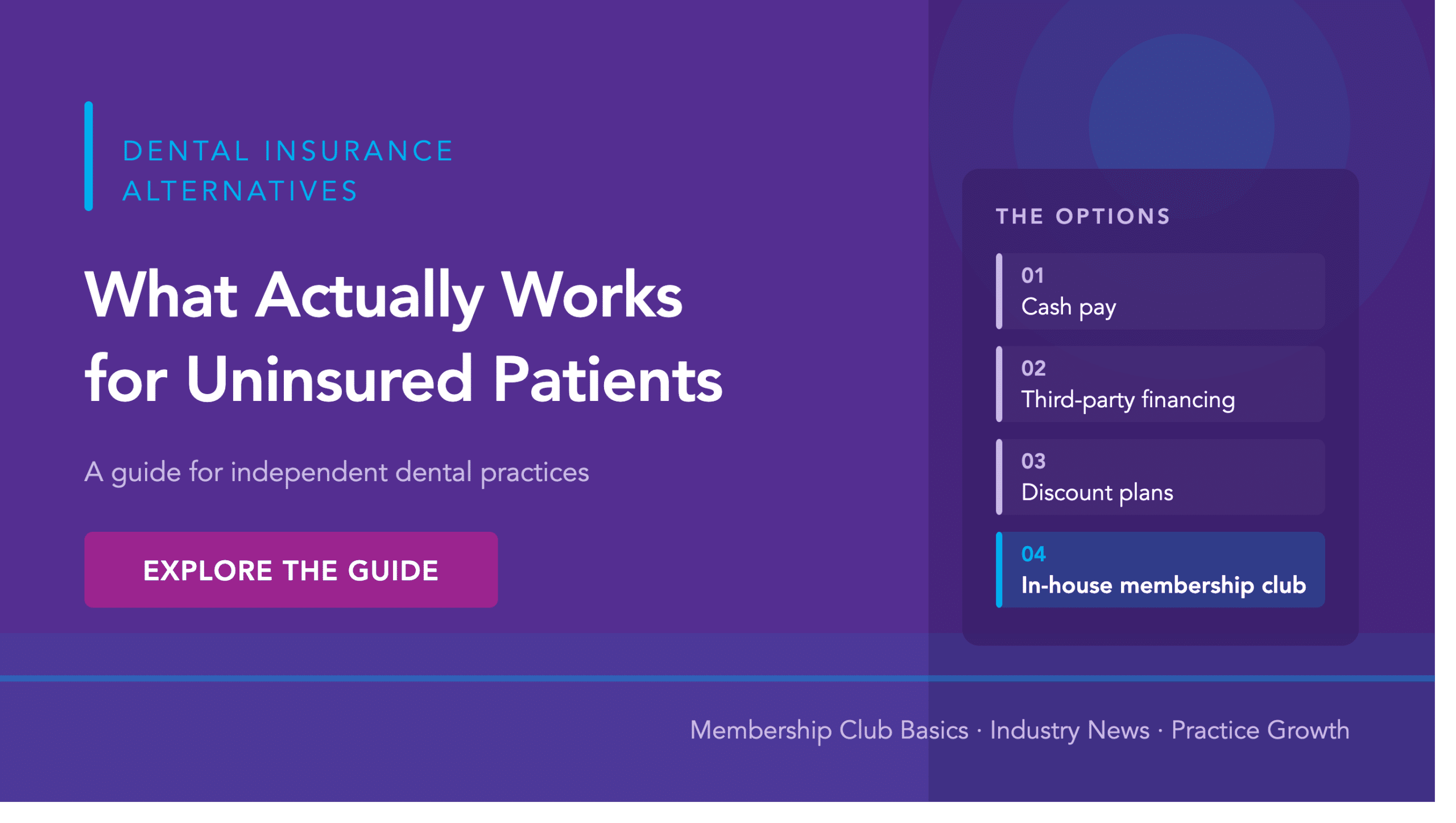
Cash Pay With Transparent Pricing
The simplest alternative: patients pay out of pocket, and your practice publishes clear, upfront pricing for common services. Transparency builds trust and reduces the friction of the unknown cost conversation. For patients who only need occasional care, this works. The limitation is that it provides no structure to encourage recurring visits, no incentive to return before something hurts, and no recurring revenue for your practice.
Third-Party Financing
Platforms like CareCredit and Lending Club allow patients to finance treatment over time. This is valuable for high-cost restorative treatment and can increase case acceptance on larger cases. It works as a supplement but not a foundation. Patients still need a reason to show up before they need expensive work, and financing does nothing to drive preventive care or recurring visits.
Dental Savings or Discount Plans
Discount dental plans charge patients a small annual fee in exchange for access to reduced rates at participating practices. They remove some of the cost barriers, but they don’t create a relationship between the patient and a specific practice. A patient enrolled in a national discount plan can use any participating provider. There’s no loyalty mechanism, no recall structure, and no recurring revenue tied to your practice specifically. As covered in our comparison blog, a discount plan is not a membership club.
There’s also a layer of patient confusion to account for. Discount dental plans come with a membership card, a plan name, and a recurring fee, so many patients assume they have dental insurance when they don’t. They may expect claims to be filed or specific procedures to be covered, then are surprised when the discount is all they get. That means your team often has to educate before they can enroll patients that have a discount plan. You should determine what the patient’s current plan actually does, what it doesn’t do, and then explain how a membership club is different. Build that conversation into your enrollment process rather than treating it as an obstacle.
In-House Dental Membership Club
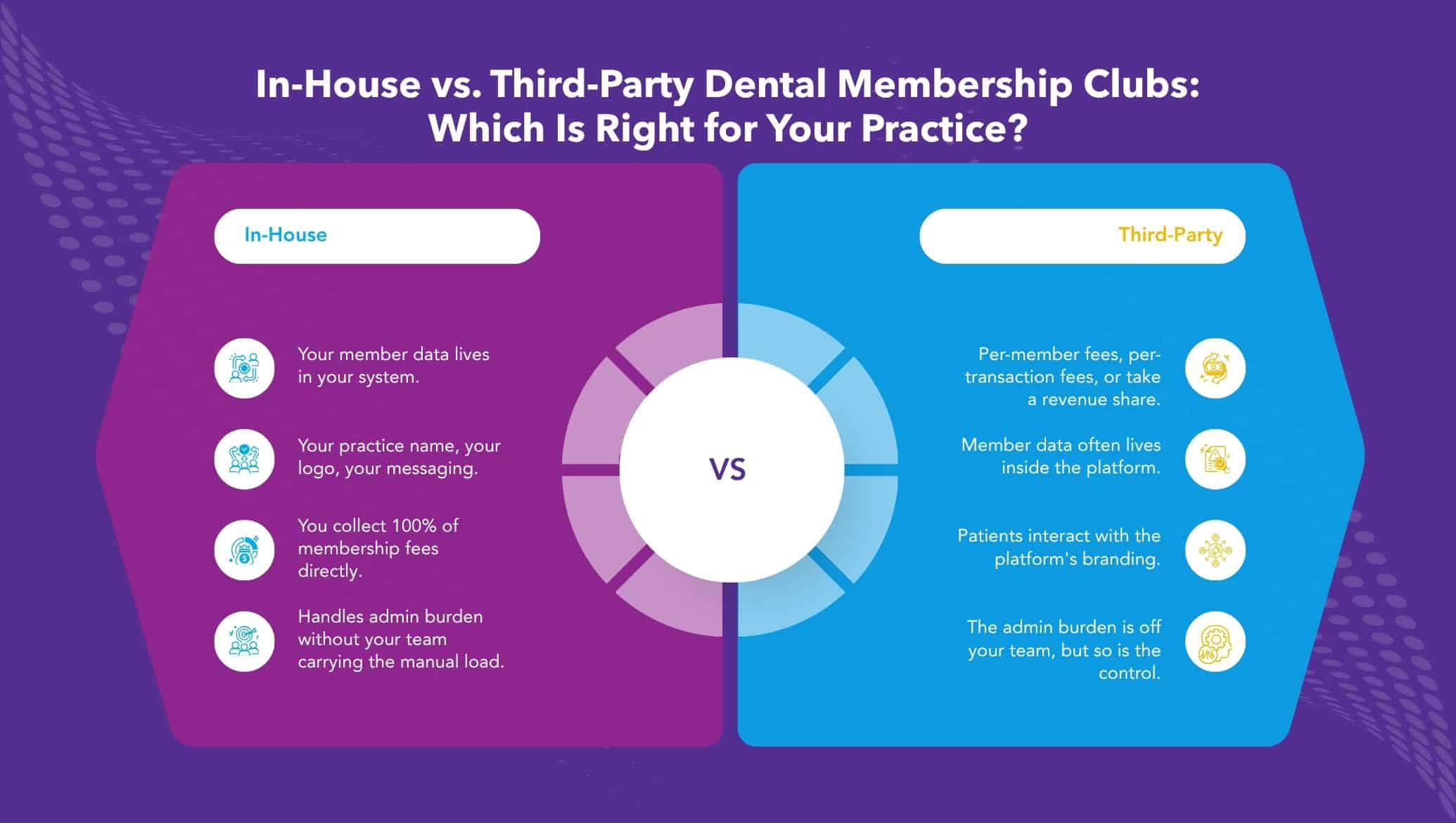
For dental practices, this is where the most meaningful alternatives to dental insurance live. An in-house membership club is a subscription-based model where patients pay a monthly or annual fee directly to your practice in exchange for preventive care and discounts on additional treatment. The fee goes to you. The relationship stays with you. The data stays with you.
Unlike discount plans, a well-structured membership club is built around recall. Members come back every six months because their plan includes those visits. That recurring contact drives treatment diagnosis, and illumitrac data shows members accept treatment at twice the rate of non-members. That’s not a coupon. That’s a structural revenue advantage built into how the club works.
Why Uninsured Patients Are Your Highest-Opportunity Audience
When practices think about growing their membership club, they often focus on converting existing PPO patients. That’s a valid strategy, but it overlooks the higher-opportunity segment sitting right in the schedule: uninsured cash-pay patients.
These patients came to you without the motivation of an insurance benefit. They’re paying out of pocket, which means they’ve already self-selected as people who value dental care enough to pay for it directly.
They’re exactly who a membership club is designed for.
Here’s how to remove the remaining barriers standing between them and a yes.
Remove the Cost Barrier with Transparent, Predictable Pricing
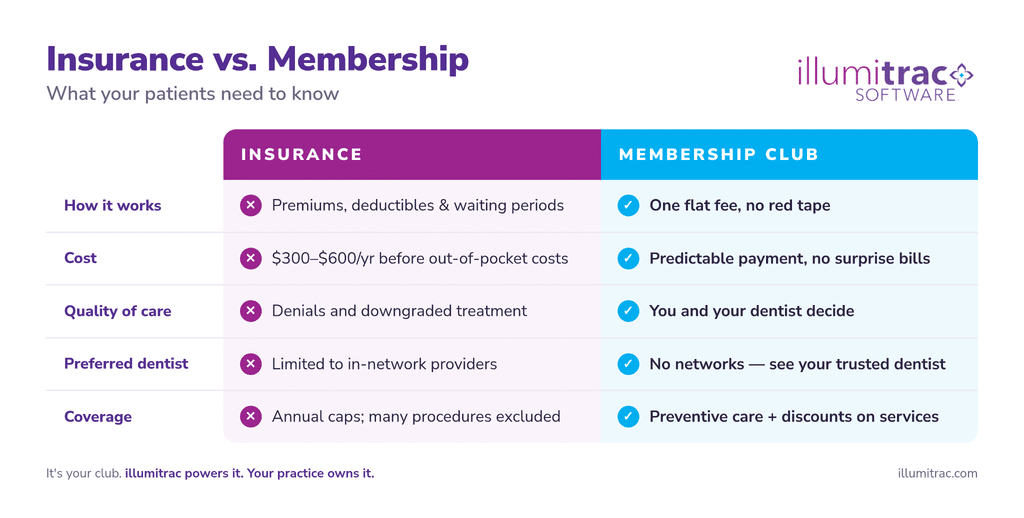
When patients don’t know what something costs, they often assume the worst and delay care. A membership club solves this at the structural level. The annual cost is fixed, the covered services are spelled out, and patients can budget for their care without anxiety about surprise bills at checkout.
For cost-conscious patients, transparency isn’t just a nice feature. It’s the deciding factor. When you can show a patient exactly what their membership costs compared to what they’d pay out of pocket for the same preventive care, the value becomes obvious. Consider keeping a simple printed comparison at the front desk for exactly this conversation. illumitrac customers receive free call and email scripts from our team.
Address the Insurance Complexity Barrier
One of the most underestimated barriers is discomfort. Patients who haven’t been in for a year or more often feel embarrassed, anxious, or defensive before they even sit in the chair. A membership club gives you a warm, non-clinical reason to re-engage them: an affordable plan that covers the visits they’ve been avoiding.
The hygienist introducing the club as “a way to take care of yourself without the insurance headache” lands very differently than a reminder that they’re overdue for a cleaning.
Frame it that way when your team presents the club. Lean into the simplicity and emphasize the value they get.
Build Trust Before Hitting the Avoidance Barrier
One of the most underestimated barriers is discomfort. Patients who haven’t been in for a year or more often feel embarrassed, anxious, or defensive before they even sit in the chair. A membership club gives you a warm, non-clinical reason to re-engage them: an affordable plan that covers the visits they’ve been avoiding.
The hygienist introducing the club as “a way to take care of yourself without the insurance headache” lands very differently than a reminder that they’re overdue for a cleaning.
Remove the Scheduling Friction
When preventive visits are included in the membership, patients have a built-in reason to book. The cleaning isn’t an expense they’re weighing. It’s already paid for. That shift in framing drives recall compliance in a way that reminder cards and automated texts simply can’t match.
How to Identify and Enroll Uninsured Patients: The Morning Huddle System
The technology to run a membership club matters. But, the system that actually drives enrollment is a human one, and it starts before the first appointment of the day.
High-performing practices build membership enrollment into the morning huddle. Before the day begins, someone reviews the schedule and flags uninsured or cash-pay patients, patients who have deferred treatment, and patients who haven’t scheduled their next recall visit. That five-minute review turns every appointment into a potential enrollment conversation.
Here’s how to structure your dental team huddle:
Identify Your Uninsured Patients
Before the day starts, identify every patient on the schedule without insurance on file. Note any who have declined treatment in recent visits or who have a gap in their recall history.
Assign a Membership Champion
The hygienist is often the most effective person to introduce the membership club, because patients trust their clinical team. When a patient mentions cost as a barrier to treatment, the hygienist can say:
“We actually have a membership club that covers today’s cleaning and gives you a discount on that. Want me to have someone walk you through it?”
The front desk or treatment coordinator handles the enrollment conversation and paperwork.
Celebrate Wins As A Team
When staff see the club growing and understand the revenue it represents, they become stronger advocates for it. Share the numbers, recognize enrollments, and make membership growth a team metric, not just a management one.

Structuring Your Club to Make the Alternative Stick
The most common reason membership clubs underperform isn’t the concept. It’s the execution. Here are the structural elements that separate a loyal club patient from one who forgets they ever joined.
Preventative Care as the Foundation
Every membership tier should include the services that drive recall: two cleanings, two exams, and necessary x-rays annually. It’s important to remember that these aren’t perks. They’re the mechanism that keeps members in the chair every six months, which is what drives diagnosis, case acceptance, and long-term retention.
If your club doesn’t include preventive care as the baseline, you’ve built a discount plan with a subscription fee. That’s a different product, and it produces different results.
Discounts That Make Additional Treatment Accessible
Members who come in regularly will need restorative and elective treatment. A standard 15 to 20% discount on non-covered services keeps that treatment accessible and increases acceptance. When patients know they’re getting a member rate, they’re more likely to say yes on the day of the diagnosis rather than deferring.
Clear, Simple Tier Structure
One to three tiers is the right range for most practices. A base adult plan, a child plan, and optionally a periodontal or enhanced plan covers the majority of patient needs without creating decision paralysis at enrollment. The general rule to follow: if your front desk can’t explain every tier in 60 seconds, simplify.
Annual Pricing Review
Membership pricing set at launch tends to stay static long past the point where it should be adjusted. Build an annual review into your calendar, and use your illumitrac Club Success Coach’s proactive outreach around pricing updates to make sure your margins stay healthy as your costs change.
Marketing Your Club to Uninsured Patients in Your Community
A membership club that patients don’t know about can’t grow. Here’s where to focus when building awareness beyond your existing patient base.
Your Website
A dedicated landing page for your membership club is the single most important external marketing asset. It should explain what’s included, what it costs, and how to enroll. Optimize it for search terms your uninsured patients are actually using: “affordable dentist near me,” “dentist without insurance,” and “dental care plan” are all high-intent queries from exactly the audience you want.
Your Office
Waiting room signage, a card at the front desk, and a brief mention in new patient intake materials all normalize membership as a standard part of how your practice operates. Don’t assume patients will ask. Put it in front of them.
Email & SMS to Your Existing Patient List
A targeted message to patients without insurance on file, introducing your new dental care plan, can generate early enrollments quickly. Keep it simple: here’s what it covers, here’s what it costs, here’s how to join.
Social Media & Digital Advertising
Targeted campaigns on Facebook and Instagram can reach uninsured families, self-employed individuals, and early retirees in your area. Amplify360’s marketing packages, built specifically for illumitrac practices, combine social media targeting, IP targeting, and Spotify ads to reach patients at multiple touchpoints across the patient journey.
Community Presence
Membership clubs are a natural fit for community marketing because they solve a recognizable problem. Local employer benefits fairs, community events, and neighborhood Facebook groups are all places where “affordable dental care without insurance” lands as a genuine solution rather than an advertisement.
Measuring Whether Your Dental Insurance Alternative Is Working
For dental practices, the best alternatives to dental insurance produce measurable outcomes. Here’s what to track once your club is live:
- Active member count across all tiers, updated monthly. This is your baseline growth metric.
- Monthly recurring revenue (MRR) from membership fees. This is the number that makes the financial case for the club internally and tracks your progress toward a meaningful revenue base.
- Member vs. non-member treatment acceptance rate. This is the clearest signal that your club is doing more than collecting dues. Members who accept treatment at higher rates are generating real production revenue on top of their membership fees.
- Churn rate. Members lost per month as a percentage of total membership. A healthy club has a churn rate under 5%. If yours is higher, the issue is usually communication cadence or a gap in the renewal process.
- New member enrollment rate. How many new members are you adding each month? A consistent enrollment rate is the sign of a team that’s presenting the club systematically rather than opportunistically.
Review these numbers quarterly with your team and your illumitrac Club Success Coach. When your staff sees the club growing and understands what each member represents in annual revenue, they become the club’s most effective advocates.
The Bottom Line on Dental Insurance Options
There are real options available for practices that want to move beyond PPO dependence and serve uninsured patients well. Cash pay with transparent pricing, third-party financing, and discount plans all have a role. But none of them build the kind of recurring, loyal patient relationship that an in-house membership club does.
The best alternatives to dental insurance for dental practices to adopt is one that produces compounding results built around preventive care, structured recall, and a direct relationship between your practice and your patients. That’s what an illumitrac membership club is designed to do, and it’s why the practices that commit to it understand that uninsured patients are actually the highest-opportunity segment in their schedule.
Ready to build your alternative to insurance? Schedule a Demo →
Check Out More Dental Membership Club Software Insights On The illumitrac Blog: